Wednesday, 10 April 2013

Preparing for our upland path work

It's now the time of year when we start thinking about getting back up on the fells and resuming our upland path repair work. This means spending a few weeks filling bags with stone in preparation for them being flown to site by helicopter to the paths that need working on.

This year bag filling has proved slightly more challenging than usual as due to all the heavy snow we've struggled to get to our rock collection sites, and also finding any rock under the thick blanket of snow. You can see in the photo below just how bad it's been. In this instance we had hoped to get up and assess the path leading to Red Tarn in Ullswater to see exactly how many bags we'd need, but in the end this proved to be fruitless.

 
Heading up to Red Tarn

As Ullswater has suffered much worse with the snow than Grasmere we managed to fill a few bags on Helm Crag while waiting for some of the snow to melt elsewhere. These will be used for landscaping around the sub-soil path that we've been recently working on.

Bag Filling at Helm Crag

Another one of our jobs this year is repairing the path on Gowbarrow. This work will require building stone drains, culverts and resurfacing. The original path was worked on a couple of years ago using a digger to create a subsoil path, but in a few areas no decent material could be found on-site for surfacing it. This has lead to the path starting to deteriorate in patches. We therefore decided that we'd fly some gravel to site which we'll use to prevent it getting any worse. The gravel is locally sourced and compacts to a hard surface, it also doesn't wash clean so won't be too intrusive.

Filling bags for the Gowbarrow job

Thankfully we had the use of a mini-digger so it wasn't long before we had all the bags filled with gravel and ready to be flown. Now fingers crossed that the weather is a bit more onside during the helicopter lifts next week.

The bags filled and ready to be flown

Tuesday, 19 March 2013

Sub-soiling on the Helm Crag path

Last year we started work on a section of footpath on Helm Crag using a technique known as sub-soiling. We were helped originally by a group of volunteers on a National Trust Working Holiday and we recently re-visited it with a few of the Fix the Fells volunteers.

The weather was at times bitterly cold and there was continual flurries of snow, but when you've got your head down working it doesn't take too long to warm up.

The fence in the photograph below shows where we finished last year. The plan was to continue the path and put in another bend. Zig-zagging the path like this reduces the gradient and this in turn helps to stabilize the path.

Starting where we finished off last year

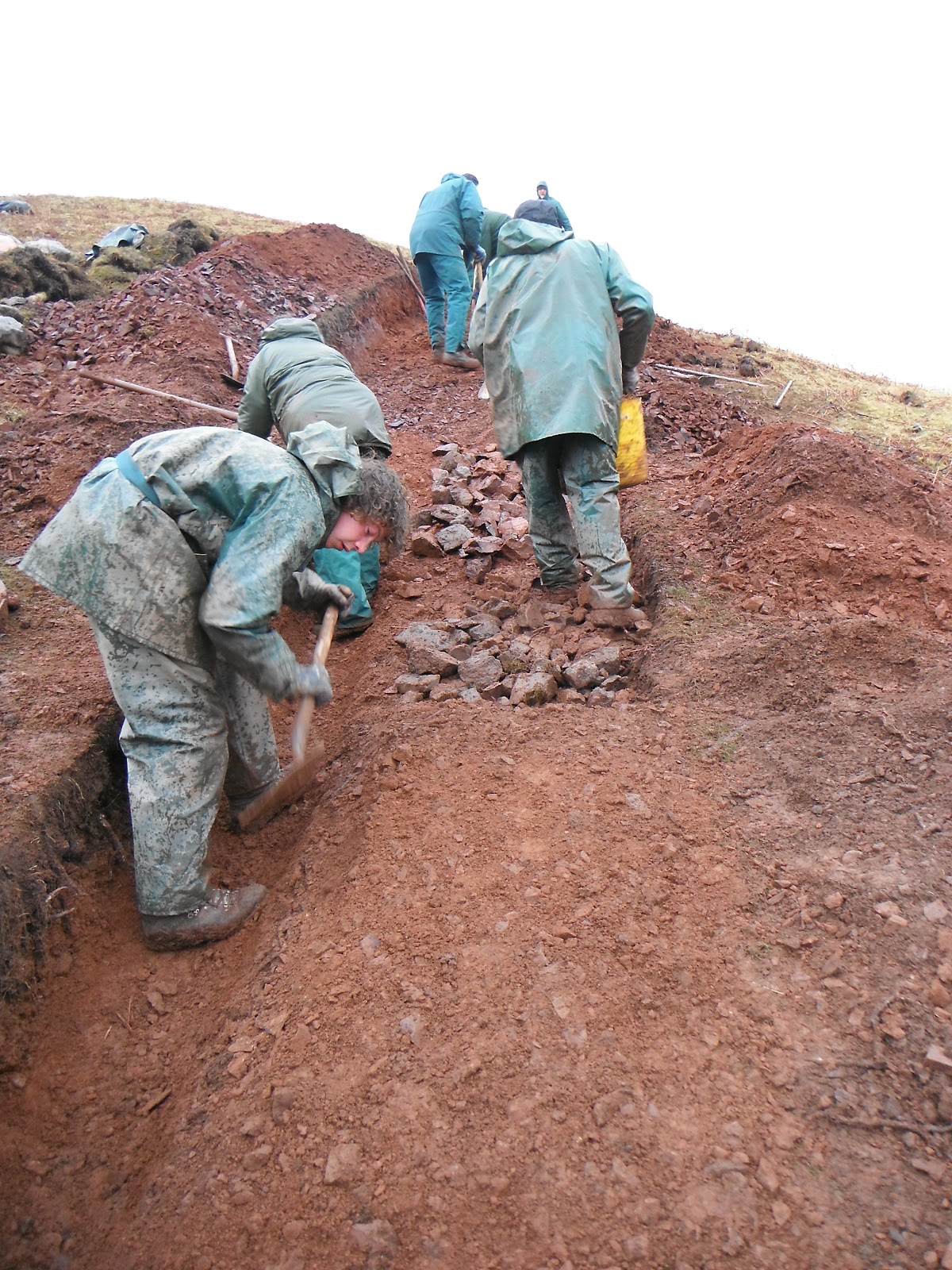
The idea is to dig off the top layer of soil until the harder (sub-soil) layer is found. This hard layer is removed, the soft upper layer is put into the hole and the sub-soil is placed back on top of it. The soil layers are basically being inverted.

It wasn't too long until the turfs were removed from the new section of path and the soil beneath them had been dug off.

Digging off the path

The next photograph shows the path with a drainage channel to the left. You can see now how the path is starting to develop. The soft material has been put back in and has been topped with broken rock and the sub-soil, which is the red-coloured material. This red soil compacts down really well and makes an excellent surface.

Topping the surface

By the end of the second day we had completed another section of path and turf lined the drainage channel. We've still got a little bit further to go until we've completely finished this section, so we'll crack on with it again later this year.

The finished section of path

Monday, 11 March 2013

Back working at Allan Bank

Since the last update we've been busily working away on the Woodland Trail at Allan Bank. It's a continuation of the work that we did last year and joins the two sections of path that we worked on to form a continuous loop.

Before we commenced work, the footpath was fairly level but rough and tended to be wet in areas. We want to make sure the trail is suitable for lots of people so we thought it'd be good idea to resurface it. It was unworked on last year as the other areas were of a higher priority due to the steepness and the likelihood that they may deteriorate.

Before starting work

Before surfacing, the first job was to sort out the drainage. We piped three areas where rainwater runs off from the bedrock and we also put in two new stone drains. The pipes were finished off with stone so you would never know they're there.

Digging in the new pipes

With this done we had to have access to get the gravel from where it was delivered to the rest of the path. In one place there was a set of steps with no way around. We therefore built a wooden ramp over the steps out of two tree trunks and some fencing rails. We'd now be able to access the path without ruining the steps.

Building the ramp

The next job was to edge the path. As part of the woodland management program at Allan Bank quite a few trees are required to be thinned out, this will allow more light to reach the ground and encourage plants such as bluebells, primroses and violets to flourish. So we took advantage of all the surplus timber to edge our new path.

Fixing the edging in place

Finally it was time to start moving the gravel. In total we'll have shovelled 30 tonnes of gravel and moved it around the woodland with our mechanical (power) barrows. It's not the speediest of jobs but it's the only way to do it.

Starting the gravelling

The new path is really starting to take shape now and when finished will provide a fantastic route around the woodland.

New section of path

Thursday, 28 February 2013

Footpath Repairs in Stagshaw Gardens

After finishing our work at Skelghyll Woods we moved on to nearby Stagshaw Gardens which is renowned for its impressive rhododendron and camellia collection.

Our original plan was to replace a section of pitched footpath, which was a little awkward to walk on, with some more formal stone risers. Though once we started removing the old pitching we soon discovered that the path was sat right on top of a section of bedrock. This made it impossible to carry out the planned work as there was no way we could sink the slate riser stones deep enough into the ground. We therefore decided to alter the route of the path and put in a gravel path instead.

The line of the new path

Once we had decided on the route we dug out the tray for the gravel  to sit in. Using the pitching stone we'd removed, we built a stone revetment (wall) to support the lower side of the path where it cuts across the angle of the slope.

Looking up the new path

The soil that was dug out to form the tray was moved and placed against the revetment to help landscape the area. It was incredibly wet while we were working on the path so we'll have to go back and check whether we need to put in any drainage. It'll also give us the opportunity to seed the area and get it looking its best.

Looking down the new path

With the new path in place it will now be much easier for all visitors to enjoy the garden when in full bloom later on in the year.

Wednesday, 6 February 2013

Path repairs in Skelghyll Woods

We've recently been working in Skelghyll Woods, just on the outskirts of Ambleside. We've been improving the drainage as over recent years the path has started to become steadily eroded in areas.

As there was little suitable rock on site we hand-picked the rock from the local quarry. We brought the rock in using our 4x4 and trailer then loaded it all into our mechanincal power barrows.

Loading up the power barrows

It wasn't long before we had distributed the rock around the woodland ready to build the drains.

Moving the rock to site

After all the materials were on site we set about constructing the stone drains and replacing a section of pipe. With these in place the path should now be much better prepared for any future heavy downpours.

One of the completed drains

Skelghyll Wood last year hit the headlines for being the home to The Grand Fir. The Grand Fir stands at 57.8m high, and is the tallest tree in Cumbria and also the tallest Grand Fir in England. It was planted in around 1860 as part of an arboretum at the Wansfell Holme country estate.

Specialist arboriculturists were called in to measure the tree and the it was all filmed with the help of Dreamtime Film. Here's the video that tells the tale...


We've been working hard on improving access around Skelghyll and we're also planning to create a new trail around the site that will be in place in the next few months. So this Springtime why not pen in a visit to see the tallest tree in Cumbria?

Monday, 21 January 2013

The BBC join us at Aira Force

At the start of the month we received the exciting news that the BBC was wanting to film some of our work at Aira Force. It transpired that their researchers had recently come across our blog and thought they'd like to film us for a new five part programme called "The Great British Winter".

So a work party was arranged for the Fix the Fells volunteers to come and help us finish off the landscaping, and we also started work on a section of gravelled path.

The BBC filming some of the volunteeers in action

On the day of filming John Pring the Lead Ranger stepped in for the interview with Ellie Harrison (who also presents on BBC's Countryfile) and explained all about Aira Force and the things we get up to in the wintertime.

The series travels around the country including pieces from RSPB Leighton Moss, The Cairngorms, The Shetland Islands and more features from The Lakes.

"The Great British Winter" will be aired the week beginning 4th March on BBC2.

Tuesday, 11 December 2012

Herringbone pitching at Aira Force

After finishing our fencing job at Stickle Ghyll we've spent much of our time repairing a section of footpath over at Aira Force. We'd already moved all the materials, by helicopter, earlier on in the year, so it was just a matter of getting ourselves and our tools to site.

Before starting work

As you can see in the photo above, the original path has become quite badly eroded. It's also right next to a steep drop, so it was decided that we should create a new path further to the right and landscape the old path to blend in with it's surroundings.

The first job was to move the slate from the helicopter drop site to where it was required. We used our mechanical power barrow to make things a bit easier and it wasn't long until we had enough stone to work with.

The rock now moved to site

As we wanted to be able to secure rock for any future work (and there's a lack of quality pitching stone in the area) we decided to use slate rather than stone gathered from the fell. Aira Force is also a more formal environment than our usual places of work so we thought that we'd use a slightly different technique, known as herringbone pitching, that would be more in keeping.

The path starts taking shape
Starting the new path

Basically, the path is created by a series of courses (similar to that of a drystone wall), with the slate sunk depth-wise into the ground. The first course ends with the the last stone a little higher out of the ground than all the others (this will be the start of the next step). The next course ends with two stones higher, the third course has three stones higher and so on. After a while you're left with a series of triangular steps as you can see in the photograph below.

Herringbone pitching at Aira Force
Herringbone style pitching

It's almost as difficult to build as it is difficult to explain, but eventually once we all started to get our heads around it, the path really started to take shape.

Completed section of path

The first section completed

Once all the stone work was done it was time to start on a section of gravelled path.

Line of the gravelled path
The line of the new gravel path

Firstly a tray to contain the gravel was dug out. All the soil removed was placed on the old footpath and the turf kept to one side to be used later on in landscaping the process.

Digging out the trench
Digging off the turf

Once the digging was finished it was time to start gravelling. The plan was to move the gravel in our "trusty" power barrow but after prising it off the frozen ground with crowbars it decided it didn't want to start so we moved all the gravel (about 6 tonnes) by hand. This was done by a combination of carrying it in rubber trugs and dragging it onto the path in the helicopter bags that were used to fly it to site.

Gravelling the trench
Starting gravelling

Eventually all the gravel was moved and and the gravel path was joined up to the stone footpath.

Finishing gravelling
Finishing off the gravelled path

All that was left to do was to landscape the old path with rubble, soil, boulders and turf so that walkers would now instinctively take the new route.