Showing posts with label Helm Crag. Show all posts

Friday, 11 November 2022

Footpath repairs at Bracken Hause

After finishing our work over on Loughrigg Fell for the year we started the job of bag filling ready for the helicopter lift at Bracken Hause. We filled around 150 bags that were flown to site in early July to go with the 40 bags that we had previously flown last year. 

Lower section before starting work

Once the bags were all in place, we began our work. It wasn't long before we discovered just how wet the path is, with the water funnelling down from higher ground and often sitting just below the path surface.

Wet

The water also seeped out of the banks on the side of the path. We added several stone drains to take the water off the path and into the stream below. 
 
Partly completed lower section

Where the footpath crossed the beck the path originally split in two with some people going up the beck and others crossing it and carrying on up above it. In the photo below the beck goes up to the left of the heli-bags and has been badly damaged through footfall causing it to become wider and lose much of the vegetation around its sides.

Beck crossing before starting work

To prevent future damage, our footpath crossed the beck and incorporated a stone wath (a stone ford), which would take more water than a conventional stone drain.

Completed beck crossing

The path then continued up the bank that had become badly eroded and widened where people had tried to find a way up or down a steep bank.

Steep bank out of river

Completed section out of river

Higher up the path the narrow track had also widened and although still mostly vegetated, it was showing clear signs of wear in a very short space of time.

Upper section before starting work

We decided to pitch this section too, as it would only be a matter of time before the grass was lost. By building a stone path the vegetation either side of the path would be protected.

Completed upper section

We again incorporated drains to take water away from the path and protect the stone work below.

Top drain from above
 
We've now completed just over half the work at Bracken Hause, so we will be back at a later date to resume the repairs.

Monday, 5 March 2018

Tree planting in Grasmere and peat bog restoration work in Ullswater

It's been a busy few weeks since our last post so here's a taster of what we've been up to.
        
Earlier on, in mid-February, we spent a week tree planting on the slopes of Helm Crag. The work was funded by Natural England. We planted 1800 scrub woodland species over an area of 6 hectares, working alongside other National Trust staff and assisted by some of the Fix the Fells volunteers.

As the trees develop, they will help stabilise the soil and reduce rainwater runoff. They will also provide a valuable habitat for birds, such as Tree Pipit and Yellowhammer, mammals and insects.

You can read in more detail about the work on the Central and East Lakes Rangers blog... here, so here are just a selection photos of the work over a very wintery week.

Having a quick debrief on the first day

Planting out the trees

Looking towards Dunnmail Raise on the last day

Later on in the month we spent a day carrying out some peat bog restoration work up on Matterdale Common with the Ullswater team and staff from Cumbria Wildlife Trust.

Over 70 per cent of peatlands in England are in a damaged state, often due to drainage, overgrazing, forestry or regular burning. This damage prevents the peat remaining waterlogged, causing plants to die off. Without vegetation cover, bare areas of peat are formed which rapidly erode. This damage can be repaired by revegetating and blocking drains to help raise the water table. 
The project has been overseen by Cumbria Wildlife Trust who've used digger contractors to do the main bulk of the work, but as a member of the Cumbria Peat Partnership we were eager to lend a hand with areas that couldn't be done with machinery.

Our main job was to plant heather on the bare areas of peat to help speed up the regeneration process.

 Heather plants ready to be planted out

So we took the trays of heather out into one of the two stock excluded areas on Matterdale Common and planted up in the barest patches.

Planting out the heather 

Areas of peat that have eroded (often as a result of grazing, historical peat cutting and water damage) may form steep banks, known as hags. These hags continue to erode, due to water flow and wind damage, forming large areas of bare peat that plants struggle to survive on.

By reprofiling the banks to an angle of around thirty degrees it gives the heather seedlings a much better chance to flourish. Many of the hags have been removed using the diggers but we were able to get to a few areas that the diggers couldn't reach and to also work on some of the smaller hags.

 Grading one of the peat hags

You can see the area where we were working in the photograph below and also the difference between the grazed and ungrazed areas. The area in the distance was fenced off about 10 years ago allowing heather and other peatland plants to return, this should further improve following the recent work.

Bundles of heather used for blocking drainage


You can learn more about peatland restoration on the Cumbria Wildlife Trust website... here.

Thursday, 30 April 2015

Repairing the path on Helm Crag

As part of our continuing repair work on the Helm Crag path, we recently arranged a weekend work-party with the Fix the Fells volunteers. Our task was to continue a section of path using the subsoiling technique, which you can read all about in a previous blog post here...National Trust Working Holiday on Helm Crag. The photograph below shows a section of completed subsoiled path, just before the area to be worked on.

 Recently repaired section of path

The work involved linking the path that we'd previously repaired to the original path-line. In the photograph below you can see the original, eroded path to the left of the photo and a bare area of grass to the right where our new path will go.

 Where the new path joins the old path

In just a few hours, most of the path had been dug off and we managed to find plenty of the red sub-soil which makes an excellent topping for the path.

 Digging out the path

We blocked off the old path (which you can see leading to the right in the following photograph) with some large boulders and used some excess soil to cover the eroded areas. At some point in the next week we'll put some grass seed down on this fresh soil to help green up the area.

 Looking down the new path

By the end of the day we'd completed the path and a turf-lined side drain which will now provide a more sustainable surface on the route to the summit.

Almost completed path

Wednesday, 11 June 2014

Resuming our upland work

Since our last blog post we've started our Fix the Fells work repairing a few of the upland paths in Grasmere, Langdale and Ullswater.

Our first job was to prepare for our work up on Gowbarrow that we'd started last year. Once again we needed to fly some materials to the work site, so we set about filling some bags with gravel with a little help from the Langdale & Grasmere ranger team.

 Loading the bags with gravel

The day of the lift went pretty smoothly and we thankfully got all the materials flown to site.

 Flying the materials on to Gowbarrow

Another job that we're working on this year is at Helm Crag.

Starting work

You can see in the photograph below that the path had previously been worked on, but some of this had started to fall out as the ground around it had eroded. The bits that had not been worked on have also deteriorated.

 Bottom section before starting work

Rock had been flown to the site previously but we're also supplementing it with rock that had been used for previous repairs.

 After a few days work

You can see in the following photograph how bad the path has become. There's a lot of loose rubble on the path and the bank to the left is badly eroded.

 Mid-section before starting work

After just a few days work the path has already started to take shape.

Mid-section after being worked on

We're also working up at Esk Hause again this year, continuing to widen the path and improve the drainage.

 Old path before repairs

It takes about two and a half hours to walk to and from the work site, plus there's also a time consuming drive on top of that, so this really eats into the time left for working. Because of this, we're being helped out by the North Lakes team this year, to help speed things along.

The North Lakes team lend a hand

Thursday, 16 May 2013

Footpath repair video

Check out this great new video that was filmed last summer while we were working up on Helm Crag. It nicely explains how and why we do our upland path work.


Wednesday, 10 April 2013

Preparing for our upland path work

It's now the time of year when we start thinking about getting back up on the fells and resuming our upland path repair work. This means spending a few weeks filling bags with stone in preparation for them being flown to site by helicopter to the paths that need working on.

This year bag filling has proved slightly more challenging than usual as due to all the heavy snow we've struggled to get to our rock collection sites, and also finding any rock under the thick blanket of snow. You can see in the photo below just how bad it's been. In this instance we had hoped to get up and assess the path leading to Red Tarn in Ullswater to see exactly how many bags we'd need, but in the end this proved to be fruitless.

 
Heading up to Red Tarn

As Ullswater has suffered much worse with the snow than Grasmere we managed to fill a few bags on Helm Crag while waiting for some of the snow to melt elsewhere. These will be used for landscaping around the sub-soil path that we've been recently working on.

Bag Filling at Helm Crag

Another one of our jobs this year is repairing the path on Gowbarrow. This work will require building stone drains, culverts and resurfacing. The original path was worked on a couple of years ago using a digger to create a subsoil path, but in a few areas no decent material could be found on-site for surfacing it. This has lead to the path starting to deteriorate in patches. We therefore decided that we'd fly some gravel to site which we'll use to prevent it getting any worse. The gravel is locally sourced and compacts to a hard surface, it also doesn't wash clean so won't be too intrusive.

Filling bags for the Gowbarrow job

Thankfully we had the use of a mini-digger so it wasn't long before we had all the bags filled with gravel and ready to be flown. Now fingers crossed that the weather is a bit more onside during the helicopter lifts next week.

The bags filled and ready to be flown

Tuesday, 19 March 2013

Sub-soiling on the Helm Crag path

Last year we started work on a section of footpath on Helm Crag using a technique known as sub-soiling. We were helped originally by a group of volunteers on a National Trust Working Holiday and we recently re-visited it with a few of the Fix the Fells volunteers.

The weather was at times bitterly cold and there was continual flurries of snow, but when you've got your head down working it doesn't take too long to warm up.

The fence in the photograph below shows where we finished last year. The plan was to continue the path and put in another bend. Zig-zagging the path like this reduces the gradient and this in turn helps to stabilize the path.

Starting where we finished off last year

The idea is to dig off the top layer of soil until the harder (sub-soil) layer is found. This hard layer is removed, the soft upper layer is put into the hole and the sub-soil is placed back on top of it. The soil layers are basically being inverted.

It wasn't too long until the turfs were removed from the new section of path and the soil beneath them had been dug off.

Digging off the path

The next photograph shows the path with a drainage channel to the left. You can see now how the path is starting to develop. The soft material has been put back in and has been topped with broken rock and the sub-soil, which is the red-coloured material. This red soil compacts down really well and makes an excellent surface.

Topping the surface

By the end of the second day we had completed another section of path and turf lined the drainage channel. We've still got a little bit further to go until we've completely finished this section, so we'll crack on with it again later this year.

The finished section of path

Friday, 21 September 2012

Dry stone walling on Helm Crag

Since our last update we've spent a fair amount of our time sorting out the drainage on the new Helm Crag path.

As you can see in the photograph below, the path takes a lot of water and if left to it's own devices heavy downpours can cause serious damage to a stone footpath. This photo was taken before we built an additional two drains higher up the path so the next time we have torrential rain the majority of the water will be removed before this point.

Rain water on the top section of path

The problem we've had with fixing the drainage is that there's a dry stone wall located right at the end of the drain stopping the flow of water. In the next photograph you can just make out the drain (halfway between the shovel and sledgehammer) coming to an abrupt end when it reaches the wall.

Drain leading into the wall

So to allow the water to run away from the path we've had to take the wall down and incorporate a gap in the wall at the end of the drain. The following photo shows the wall after we've started to rebuild it. Putting in these drainage gaps has turned out to be a bigger job than expected. As the wall was in a poor state of repair, once we started taking it down it had a tendency to fall down on it's own. This created a much larger gap than we really wanted!

A hole for the water to flow through

After a couple of days work the wall was rebuilt up to it's original height again. So next time there's a massive downpour (which probably won't be too far in the future) we're now fully prepared for it!

The finished wall

Wednesday, 29 August 2012

National Trust Working Holiday on Helm Crag

We recently took a break from working on the stone pitched path at Helm Crag as we were joined by a National Trust working holiday group. They were here for a week, coming to help us out with our footpath repairs.

As part of our repair work on Helm Crag we identified a section, leading up towards the summit, that we'd been keeping a close eye on for many years that had steadily been deteriorating. The path would have been difficult to repair with stone as it's not particularly steep, meaning there would be plenty of opportunity for people to step off the path and walk beside it.  There is also very little in the way of features, rough terrain or large rock about so it would have been difficult to landscape. This could have eventually ended up with an erosion scar (as you can see in the photo below) alongside the stone path, not ideal.

The section before starting work

So we decided the best option to repair the path would be to create a sub-soil path. This technique, also known as soil inversion, is an ancient technique that dates back as far as Roman times.

Starting work on the path

Firstly we had to select the best route to take with the new path. The path will zig-zag up the hill crossing the original (eroded) path line. We have to snake the path like this to reduce the gradient which will mean once we've created the new surface the chance of it becoming mobile is greatly reduced. It will also make the path easier to walk on.

Removing the turfs

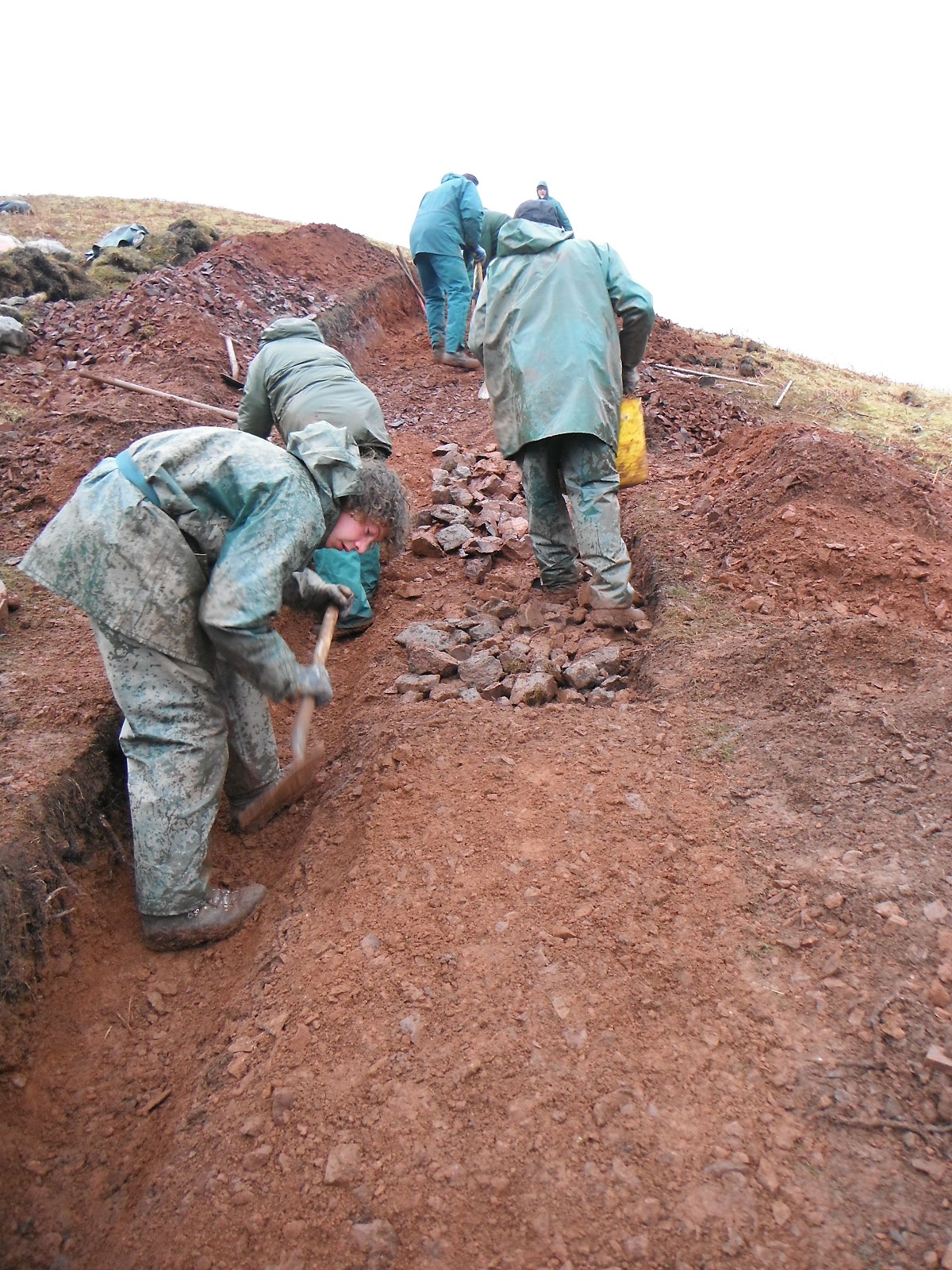
With the route decided, the first job was to remove the turfs from the line of the path and place them to one side so that we could use them later.

Digging off the topsoil

With this done, the next job was to dig off the topsoil, again this was placed to one side as it would also be needed later. This dark layer, rich in humus (organic matter), varied in depth, but beneath it was a layer of compacted red sub-soil. The idea is to remove this compacted soil, put the topsoil back on the path and then put the sub-soil on top of it. This new surface is much more hard wearing and compacts down well, creating a more sustainable surface.

Digging the drain

Next a side drain was created on the top side of the path. This would catch any water that runs down the hill, and shed it away from the new path. Much of the drain went through areas of bedrock, so this all had to be chipped out with crowbars to make sure the drain would sit well below the surface of the path.

Freshly turfed drain and completed path

Once the drain was dug out, it was lined with turfs using the grass that had been originally dug off. This turf lining will provide a protective layer and prevent the soil in the drain from being washed out.

A wet finish to the week

There was plenty of showers throughout the week and the last day proved to be a particularly wet one. But the volunteers did a wonderful job, and the rain was at least useful to check that our new drains were working. This type of work is so labour intensive and so it's great to get more people involved, it really is a fantastic example of "many hands make light work". Thanks!