Showing posts with label Fix the Fells. Show all posts

Wednesday, 4 February 2026

Repairing the path and creating ponds at Stythwaite Steps, Easedale.

Our second path repair project of 2025 focussed on a section of footpath at Easedale, near Grasmere, just above the bridge at Stythwaite Steps.

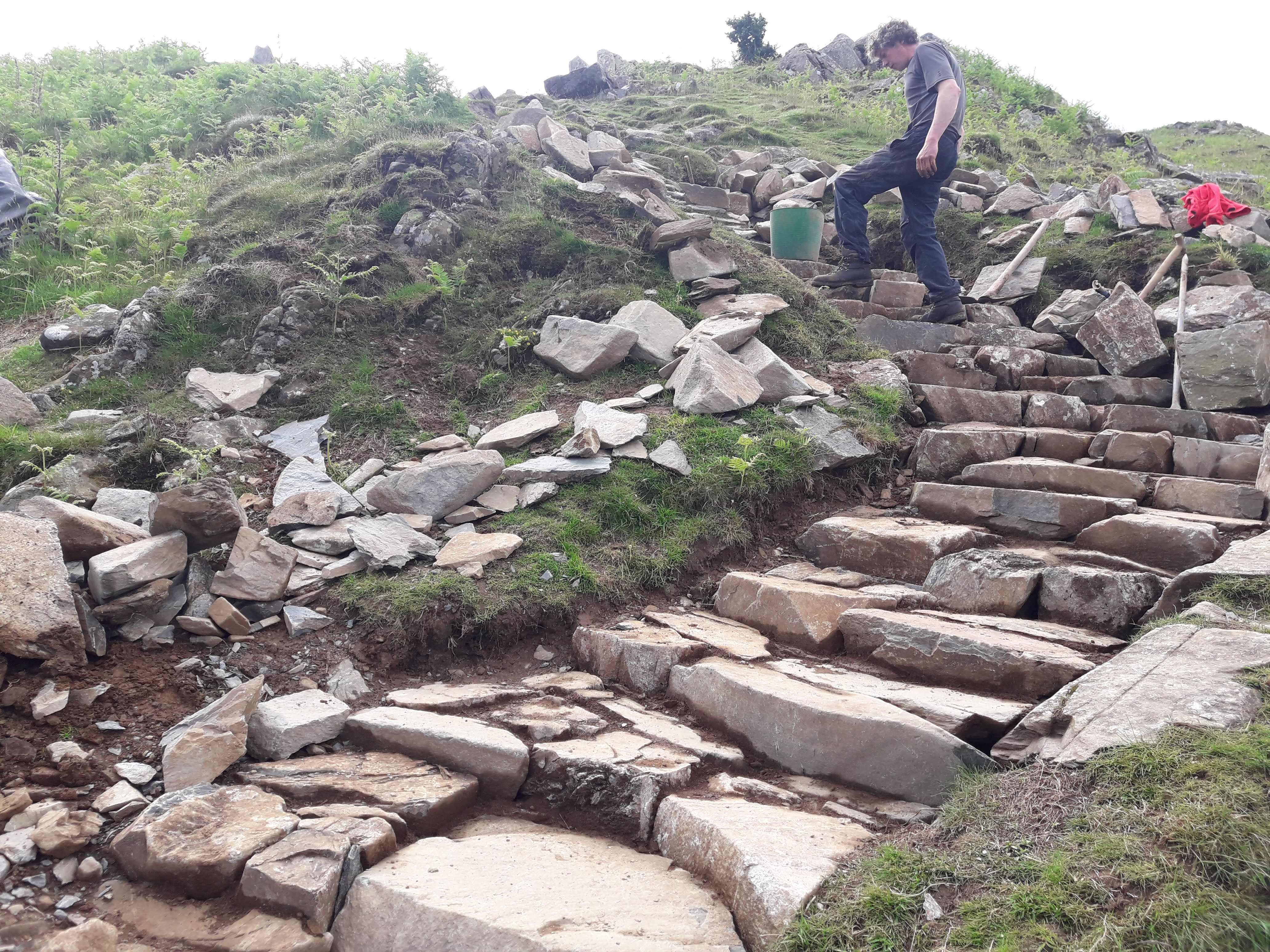
The first two sections of the path rose quite steeply, forming a stony gully that had become noticeably worse over recent years. Due to the steepness, it was decided that the whole length of the path needed to be repaired.

Section 1 (before)

Section 1 (during)

Section 1 (after)

A couple of stone drains were incorporated into the stone pitched path to remove rainwater away from the path and help prevent damage to the new work. The drains ran into a side gulley (seen to the right in the picture below), which was actually the original path in the early 2000s but the path has since moved onto the desire line that is now being repaired.

Section 2 (before)

Section 2 (during)

Section 2 (after)

Section three of the path started to level off a little as it approached a flat boggy area.

Section 3 (before)

Section 3 (during)

All the material that had been dug out while building this section of the path (the bank of soil to the left in the above picture) was moved higher up the path to help landscape the flat area and produce a series of pools (more detail on this in a moment).

Section 3 (after)

During heavy rain the area above section three is prone to flooding so we decided to build a stone wath (ford) into the path to allow any water that builds up to flow down into the wath and into the top of the side trench (the old path line). 

Stone wath in section 3 being constructed

Using a wath allowed us to redirect the water only as it naturally builds up during periods of flooding. Using a standard stone drain here would have required digging a trench, from the wet area into the drain, which would have meant a steady flow of water out. The wath enabled us to leave the surrounding area boggy.

Completed wath and landscaped bank

Section four was a wide flat boggy area that had got wider, and wider, as people had tried to avoid the mud.

Section 4 (before)

Section 4 (during)

We decided that to help improve the habitat in the area, we'd hold some of the water back and create a series of pools. This would also have the effect of discouraging people from wandering off the path.

All the spoil (turf, soil and stone) from the top two sections of path was used to build up banks and three small ponds were dug out to a depth deeper than the summer water level, to allow water to remain in the ponds all year round.

Section 4 (after)

Within just a few weeks of the ponds being dug, a common newt was found and several species of dragonfly were also noted visiting the ponds and egg laying. 

Completed path at section 4

Another stone wath was built into section four to allow water from the boggy area to the left of the path to steadily flow across into the ponds to the right.

Stone wath in section 4

It's been a great section of path to work on and to get involved in some small scale habitat creation. We've had some really positive feedback from walkers who regularly walk this section of path and who struggled navigating the boggy section. It'll be great to see how the new ponds settle in after a few years of being left to their own devices. Creating ponds as part of this path project was a first for us, but it's something we'll look to do again in future, where appropriate.

Thursday, 27 November 2025

Kidsty Howes, Improvements to the Coast to Coast Route.

Since our last update we've been busy working on two different projects, one in Easedale, just outside Grasmere (which will appear in a later blog post) and the other at Kidsty Howes in Haweswater, where we've been repairing a section of Wainright's Coast to Coast Walk.  As our base is near Grasmere, it took us around 2 hours to get up to the worksite while working at Haweswater, and this commute considerably ate into our working days there.

Flying the stone on to site

Due to the amount of exposed bedrock, this part of Kidsty Howes can be difficult to descend and this has led to extra routes developing as people try to avoid the bedrock areas. As the Coast to Coast Walk is being upgraded to a National Trail, it was decided that access through the area needed to be improved and these improvements would also help reduce the risk of increased erosion brought about by the potential increase in footfall. 

Section 1 (before)

As you can imagine, the work was particularly challenging as it entailed breaking through the exposed bedrock with crowbar and sledge hammer, to create six sections of stone path.

Section 1 (during)

The first section was through a deep gulley, which created additional difficulties with landscaping. The large peaty bank on the left hand side had to be graded back to produce a more natural looking bank. The soil generated was used to fill in other areas that had been eroded just to the top right of the path and also below it. We then had to cut turf from areas that were well away from the site and we used this to cover over the areas of newly exposed peat. The areas where the turf had been cut were then seeded, to help them recover.

Section 1 (after)

The next section had even more exposed bedrock, meaning that even more of it had to be chipped out to get the path in, and the deeper into the rock you go the harder it gets! This is because the exposed surface of the bedrock has generally been weathered and broken down to some extent by the elements, whereas the deeper rock is unweathered and therefore much more solid.

Section 2 (before)

Section 2 (during)

With so much exposed bedrock, the area had to be carefully landscaped with large stones against the edges of the path and plenty of turf to cover over the rubble and bedrock.

Section 2 (after)

Section three of path followed the line of least resistance through the bedrock via a natural water-worn gulley.

Section 3 (before)

Progress on all sections was slow, with generally no more than one step built each day, and many days were spent just breaking the bedrock.

Section 3 (during)

You can see in the photos above and below how the path follows a natural fault in the rock. Each rock for the steps has to be carefully selected to fit the gap with very little room to spare.

Section 3 (up close)

 
Section 3 (after)

Section four involved pitching the path through another gulley to remove a narrow awkward drop off.

Section 4 (before)

Section 4 (after)

Further up the path, section five again followed the line of the gulley. Working in these tight gullies meant there was often not enough room to swing a sledgehammer, so the rock had to be chipped out using only crowbars and any fine tuning was done with a small stone hammer.

Section 5 (before)

Section 5 (after)

The final section was a short length of path, and again the side of the path was turf lined to cover over the rubble that was generated and to give a more natural feel to the surrounding area.

Section 6 (before)

Section 6 (after)
 
In addition to the work above, we also added five stone cross-drains to remove rainwater from the path, which should help prevent any further damage.

It's been a very challenging job, but it's made a huge difference for people coming down the path carrying large heavy rucksacks, which made it a struggle for them to safely navigate the bedrock, meaning they were forced to take other, less sustainable routes.

Sunday, 19 June 2022

Returning to Loughrigg

For the third consecutive year, we've been back repairing the path on Loughrigg Fell. Once again, we've been replacing sections of the original path and also adding some stonework to areas that have suffered from erosion damage, this time helped out by new team member Josh.

The following two photographs show a section of footpath immediately above where we finished last year. You can see that the path has eroded quite badly and has formed a sizeable gulley.

Lower section before work

Lower section after work

The next two photographs show the top of the lower section as it joins up to the section above.

Old section of risers

New section of path

The path had previously been worked on, but the steps were too high, which made it really uncomfortable to walk down. The new path has shallower steps set at different heights, making the descent a little easier.

The next bit of path that we replaced went through a narrow bedrock gulley. You can see the rock outcropping below-left and to the right of the original steps in the photo below. Again the steps were too high, so had to be replaced. 

Bedrock section (before)

As the bedrock was just below the original steps, a lot of it had to be broken out using crowbars and sledgehammers in order to set the new path in place. 

Much of these first two sections sat on bedrock that had to be chipped out. The rubble was then removed away from site using plastic trugs. If it had been left next to the path it would have constantly fallen back onto the new footpath and would also have proved difficult to landscape due to the lack of soil to cover it.

Bedrock section (after)

The next section was a steeply sloped bit of path that is extremely difficult to walk down. Here we're removing the old path, reusing any suitable stone and resetting it into low steps that are much easier to walk on.

Sloped section before

Sloped section after

The final bit of path that we worked on this year was slightly higher up the fell. Again bedrock was causing an issue (you can just make it out to the left of the black bags in the photograph below) by forcing people to find a route around it, causing the the path to widen.

Upper section (before)

We chose a line that meandered up through the bedrock and once the area has been fully landscaped and reseeded the new path should blend in well with its surroundings and prevent the path from over widening.

Upper section (after)

Friday, 25 June 2021

Working back on Loughrigg Fell

Our return to upland work this spring meant a return to the footpath on Loughrigg Fell. We started the season by gathering some more stone for the repairs, which was flown on to site.

Flying stone on to Loughrigg

For this section of path we've decided to change the line to add more bends in the path and remove some of the gradient. You can see in the following two photos where the path has been moved to the right of the original footpath. 

Original path and new line

You can also see that the old style of pitching is put in at the same angle as the slope, which makes it difficult to walk down, particularly when wet.
 
Lower section of path before landscaping

Lower section of path after landscaping

The old path line was landscaped by covering it with soil and turf that had been removed while building the new path. We left a section of temporary fence in to discourage people from walking in the area while the seed is beginning to grow. Once it's had time to bed in we'll remove the fence.


Middle section of path after landscaping

You can see in the following photo a section higher up the path where large stone steps had been used. The height of the steps were difficult to walk down and you can see to the left of the image where people have been walking around them.

Old stone risers

The following two photographs show the same section during repair work and after landscaping.

Upper section after removal of the old stone risers

Putting down grass seed on the upper section 

The final section that we worked on this year was just above the previous two images and was another bad mixture of angled path and more high steps.

The old section of path was built on top of bedrock. We had to remove the old path and chip out the bedrock before the new path could be built. The following two photos show the old path and the new path after landscaping.

Old path in bedrock section

Replaced path

We'll be back working on Loughrigg again next year, continuing up through the bedrock and a few more repairs higher up the path.